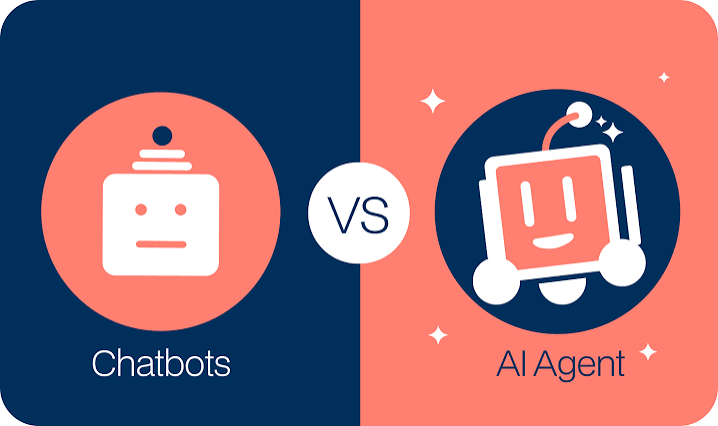

Artificial intelligence is changing the way people use software with the help of AI. Two of the most used tools that are increasingly common are AI chatbots and AI agents. Although they sound common, they have different purposes.
An AI chatbot is primarily designed to communicate with users through conversations. It can answer questions, explain information, generate content, and help users find what they need.
An AI agent goes a step further. Instead of only responding to a user’s request, an AI agent can reason about a goal, decide what actions to take, use tools, interact with other systems, and complete multi-step tasks.
For example, a customer might ask a chatbot, “What is the status of my order?” The chatbot can look up the order and provide an answer.
An AI agent could potentially take the request further. It could check the order status, determine that the package is delayed, contact a shipping service, identify available options, and initiate an appropriate action based on the user’s instructions. This difference is becoming increasingly important as businesses adopt AI-powered software.
In this guide, we’ll explain AI agents vs. AI chatbots, how they work, their differences, advantages, limitations, and practical examples to help you understand which technology is appropriate for different situations.

What Is an AI Chatbot?
An AI chatbot is software that uses artificial intelligence to communicate with people using natural language.
Traditional chatbots often relied on predefined rules. For example:
- User selects “Order status.”
- Chatbot asks for an order number.
- User provides the order number.
- Chatbot displays the status.
Modern AI chatbots can use large language models (LLMs) to understand natural-language questions and generate more flexible responses. Instead of requiring users to select predefined buttons, an AI chatbot can understand requests such as:
“Can you tell me where my order is and when I should expect it?”
The chatbot can interpret the question and generate an appropriate response.
Common AI chatbot capabilities
AI chatbots can be used for:
- Answering customer questions
- Providing product information
- Writing and editing text
- Summarizing documents
- Explaining technical concepts
- Providing customer support
- Helping employees find information
- Generating ideas
- Translating text
- Assisting with coding
- Searching a company’s knowledge base
Examples of AI chatbot applications include customer-service assistants, website chat widgets, internal employee assistants, and general-purpose AI assistants.
How Do AI Chatbots Work?
A modern AI chatbot typically contains several components.
1. User input
The process begins when the user sends a query on the chat prompt.
For example:
“What is your return policy?”
2. Language understanding
An AI model processes the message and determines what the user is asking. The system identifies concepts such as:
- Return policy
- Customer request
- Relevant information
3. Knowledge retrieval
If the chatbot is connected to a knowledge base, it may retrieve relevant information from company documents, webpages, product databases, or other sources.
4. AI-generated response
The language model uses the available context to generate a response in a natural tone.
For example:
“You can return unused products within 30 days of purchase. Please keep your original receipt.”
5. Response delivery
The answer is sent back to the user through a website, mobile application, messaging platform, or other interface. The important point is that the chatbot’s primary function is conversation.
What Is an AI Agent?
An AI agent is an AI-powered system designed to accomplish a goal by reasoning about tasks and taking actions. Instead of simply answering a question, an agent does more than answer the query. It may be involved in:
- What needs to be done
- Which information is required
- Which tools should be used
- What actions should be performed
- Whether the result is satisfactory
- What should happen next
For example, imagine a user says:
“Find me a suitable hotel in Kathmandu for three nights and prepare the booking details.”
A conversational chatbot might provide hotel suggestions. An AI agent could potentially:
- Search available hotels
- Compare prices
- Check dates
- Consider the user’s requirements
- Filter the options
- Select an appropriate option based on the user’s instructions
- Prepare booking information
- Ask for confirmation
- Complete an authorized booking
The agent is therefore focused not only on conversation, but also on task completion and other actions.
How Do AI Agents Work?
AI agents can have a more complex architecture than ordinary chatbots. A simplified AI agent workflow looks like this:
User goal → Planning → Tool selection → Action → Observation → Reasoning → Next action → Result
For example, consider an AI agent responsible for processing a customer refund.
Step 1: Understand the request
The customer says:
“I want a refund for my recent purchase.”
Step 2: Gather information
The agent checks:
- Customer account
- Order history
- Payment information
- Refund policy
Step 3: Make a decision
The agent determines whether the purchase qualifies for a refund.
Step 4: Use a tool
The agent might interact with the company’s payment or order-management system.
Step 5: Take action
If authorized, it could initiate the refund.
Step 6: Report the result
The agent tells the customer:
“Your refund has been initiated. It should appear in your account within the expected processing period.”
This is fundamentally different from a chatbot that only provides information about the refund policy.
AI Agents vs AI Chatbots: Key Differences
The biggest difference is what the system is designed to accomplish.
| Feature | AI Chatbot | AI Agent |
|---|---|---|
| Primary purpose | Conversation | Goal and task completion |
| Answers questions | Yes | Yes |
| Natural-language interaction | Yes | Yes |
| Uses knowledge bases | Often | Often |
| Uses external tools | Sometimes | Frequently |
| Performs actions | Limited | Core capability |
| Multi-step tasks | Limited | Strong capability |
| Planning | Usually limited | Often important |
| Autonomy | Low to moderate | Moderate to high |
| Decision-making | Usually simple | More advanced |
| Workflow automation | Limited | Strong |
| Human approval | Often unnecessary for answers | Often useful for important actions |
The distinction is not always absolute. Some modern AI chatbots have tool-use capabilities, while some AI agents have conversational interfaces. Therefore, the difference is better understood as a potential rather than two completely separate technologies.
AI Chatbot Example: Customer Support
Imagine an online store with an AI chatbot.
A customer asks:
“What payment methods do you accept?”
The chatbot searches its knowledge base and responds:
“We currently accept Visa, Mastercard, PayPal, and other supported payment methods.”
Another customer asks:
“Do you ship to Nepal?”
The chatbot can retrieve the relevant shipping information and answer the question. This is an excellent use case for an AI chatbot because the primary requirement is providing information through conversation.
AI Agent Example: Customer Support Automation
Now imagine the customer says:
“My package hasn’t arrived. Can you check what’s happening and help me resolve it?”
An AI agent could potentially:
- Identify the customer’s order.
- Check the order-management system.
- Retrieve the tracking number.
- Contact or query the shipping system.
- Determine the current delivery status.
- Check the company’s late-delivery policy.
- Determine available options.
- Offer the customer an appropriate resolution.
- Perform an authorized action.
Instead of simply explaining the process, the system can participate in the workflow.
AI Chatbots Are Not the Same as Simple Rule-Based Bots
It’s important not to confuse modern AI chatbots with traditional rule-based chatbots. A rule-based chatbot might work like this:
User: “Hello”
Bot: “Hello! Choose an option.”
- Products
- Orders
- Support
The user must follow a predefined path. An AI chatbot can understand much more flexible language.
For example:
“I’m looking for a laptop under $1,000 that’s suitable for programming.”
The AI chatbot can interpret the intent and provide a natural response. However, being powered by an advanced language model does not automatically make a chatbot an autonomous AI agent.
The key question is:
Can the system independently use tools and take actions to accomplish a goal?
AI Agents Can Use Tools
Tool usage is one of the most important characteristics of modern AI agents. An AI agent can potentially connect to:
- Databases
- APIs
- Search engines
- CRM systems
- Email platforms
- Calendars
- Payment systems
- Inventory systems
- Project-management tools
- Business software
- Internal company systems
For example, a sales AI agent could receive:
“Find our customers who haven’t purchased anything in the last six months.”
The agent could:
- Query the CRM.
- Filter customers.
- Analyze purchasing information.
- Create a list.
- Generate a report.
- Potentially prepare an outreach campaign.
A chatbot might explain how to perform these steps.
An agent can potentially perform them.
AI Agents Can Handle Multi-Step Tasks
Another major difference is the ability to handle workflows. Consider a simple employee request:
“Schedule a meeting with the marketing team next week.”
A basic chatbot might tell the employee how to schedule a meeting. A connected AI agent could potentially:
- Check the employee’s calendar.
- Identify available times.
- Check participants’ calendars.
- Find a suitable time.
- Create the calendar event.
- Add participants.
- Generate an agenda.
- Send invitations.
This is a multi-step workflow. The AI is not merely answering questions. It is coordinating several actions.
AI Agents and Memory
Memory can also be an important factor in agent-based systems. For example, an AI assistant might remember information relevant to an ongoing workflow, such as:
- User preferences
- Project information
- Previous interactions
- Current task state
- Business rules
- Previous actions
However, memory is not exclusive to AI agents. AI chatbots can also maintain conversation history and user context. The difference is how that information is used. An agent may use memory to help determine what action should happen next.
AI Agents and Planning
Planning is another important capability. Suppose a user says:
“Help me organize a product launch.”
That’s not a single action.
An AI agent might break the goal into tasks such as:
- Define the launch date.
- Create a marketing plan.
- Prepare a content calendar.
- Identify required assets.
- Create project tasks.
- Assign deadlines.
- Track progress.
The agent can then work through these tasks. A chatbot could still help with each individual step, but the agent-oriented approach focuses more heavily on managing the overall objective.
Real-World AI Agent Use Cases
AI agents can be useful for many business workflows.
1. Customer Service
An AI agent can:
- Check orders
- Retrieve customer information
- Process eligible requests
- Update records
- Escalate complex issues
2. Sales
Sales agents can potentially:
- Research prospects
- Update CRM records
- Qualify leads
- Draft emails
- Schedule meetings
- Prepare sales summaries
3. Software Development
AI coding agents can help developers:
- Analyze code
- Find bugs
- Create files
- Modify code
- Run tests
- Investigate errors
- Prepare changes
Human review remains important, especially for production systems.
4. Marketing
AI agents can potentially assist with:
- Market research
- Content planning
- Keyword research
- Campaign analysis
- Reporting
- Customer segmentation
5. IT Operations
An AI agent could help monitor systems, investigate alerts, gather diagnostic information, and assist with incident workflows. The level of autonomy should depend on the potential consequences of mistakes.
Real-World AI Chatbot Use Cases
AI chatbots are especially useful where users primarily need information or conversational assistance anytime.
Website support
A chatbot can answer:
“What services do you offer?”
Product assistance
A chatbot can explain:
“What’s the difference between these two plans?”
Knowledge management
Employees can ask:
“What is our vacation policy?”
Educational assistance
Students can ask:
“Explain photosynthesis in simple terms.”
Writing assistance
Users can request:
“Rewrite this paragraph professionally.”
These are primarily conversational tasks.
Advantages of AI Chatbots
AI chatbots offer several benefits.
Easy interaction
Users can communicate using normal language rather than learning a complicated interface.
Fast responses
Chatbots can provide answers almost instantly.
24/7 availability
A chatbot can operate continuously.
Scalable support
One AI chatbot can potentially assist many users simultaneously.
Knowledge access
A chatbot connected to a good knowledge base can make information easier to find.
Limitations of AI Chatbots
AI chatbots also have limitations.
They may provide incorrect information
Large language models can generate inaccurate answers.
Limited ability to take action
A chatbot without tool access may only be able to provide instructions.
Context limitations
Long or complicated workflows can be difficult to manage.
Integration requirements
A useful business chatbot often needs access to company data and systems.
Security concerns
Connecting a chatbot to sensitive information requires careful access control and security design.
Advantages of AI Agents
AI agents can provide additional capabilities.
Task automation
Agents can potentially automate multi-step workflows.
Tool integration
They can interact with APIs, databases, and business software.
Goal-oriented behavior
Instead of responding to isolated questions, agents can work toward broader objectives.
Reduced manual work
Agents can automate repetitive processes.
Workflow coordination
They can connect multiple steps that would otherwise require human intervention.
Limitations and Risks of AI Agents
Greater autonomy also introduces additional risks.
Incorrect actions
An AI agent that makes a wrong decision can potentially cause more damage than a chatbot that simply gives an incorrect answer.
Security risks
Agents with access to business systems require strong authentication and authorization controls.
Excessive permissions
An agent should generally have only the permissions necessary for its job.
Unexpected behavior
Complex workflows can produce unexpected results, particularly when AI models interpret ambiguous instructions.
Human oversight
Important actions may require human approval.
For example, an organization might allow an agent to prepare a financial transaction but require a human to approve it.
AI Chatbot vs AI Agent: Which Should a Business Use?
The answer depends on the problem.
If your primary requirement is:
- Answering questions
- Providing information
- Helping customers
- Searching a knowledge base
- Conversational assistance
An AI chatbot may be appropriate.
If your requirement involves:
- Multi-step workflows
- Tool usage
- Business-system integration
- Automation
- Task execution
- Goal-oriented processes
An AI agent may be more appropriate. In many cases, businesses can utilize both. For example, a website might have an AI chatbot as the interface while an AI agent operates behind the scenes to perform tasks.
AI Chatbot + AI Agent: The Future of AI Assistants
The difference between chatbots and agents may become less obvious as AI systems become more capable. A future customer-support system could look like this:
Customer → Conversational AI → AI Agent → Business Tools → Result
The user communicates naturally with the AI. The conversational layer understands the request. The agent determines what needs to happen. The agent uses authorized tools. The result is returned to the user.
For example:
“Can you check my order and change the delivery address?”
The system could understand the request, verify the user’s identity, check whether the order can still be modified, update the appropriate system, and confirm the result.
The user experiences this as one conversation. Behind the scenes, however, multiple AI and software components may be working together.
A Simple Way to Remember the Difference
A useful way to think about the difference is:
AI chatbot = Talk
AI agent = Think + Act
This isn’t a technical definition, but it provides a useful insight for non-technical people. A chatbot is primarily focused on communication. An agent is primarily focused on achieving a goal through actions.
For example:
Chatbot:
“Your refund policy allows returns within 30 days.”
Agent:
“I’ve checked your order, confirmed that it qualifies, and submitted the refund.”
The first provides information.
The second performs a workflow.
The Technology Behind Both Systems
AI chatbots and AI agents can use many of the same underlying technologies.
These can include:
- Large language models
- Natural language processing
- Retrieval-augmented generation (RAG)
- Vector databases
- APIs
- Databases
- Tool calling
- Authentication systems
- Workflow engines
- Memory systems
- Monitoring and logging
The architecture depends on the application.
A simple website chatbot might only need an AI model and a knowledge base.
A sophisticated AI agent may require:
- Multiple tools
- Planning mechanisms
- Authentication
- Permissions
- Database access
- Workflow management
- Error handling
- Human approval
- Monitoring
This makes agent systems more powerful, but also more complex to build and manage.
AI Agents vs AI Chatbots: Final Comparison
The difference can be summarized as follows:
AI chatbot
Primarily designed to communicate with users and provide answers or assistance with the data provided during the training phase.
AI agent
Designed to pursue a goal by reasoning, using tools, making decisions, and performing actions.
A chatbot may tell you how to complete a task.
An agent may be able to complete the task.
However, the distinction is not always binary. Modern AI systems can combine conversational interfaces, tool use, memory, planning, and automation. Therefore, instead of asking whether chatbots or agents are universally better, businesses should ask:
What does the AI system actually need to accomplish?
If users mainly need answers to their queries, a chatbot may be sufficient for the business. If users need the system to perform complex tasks, an agent architecture may provide the capabilities required to handle the flow.
Conclusion
The difference between AI agents and AI chatbots comes down largely to their purpose. An AI chatbot is primarily built to communicate. An AI agent is built to accomplish goals and take actions.
Chatbots are useful for answering questions, providing information, supporting customers, and interacting with users. AI agents extend these capabilities by connecting AI models to tools, data, applications, and workflows.
The most interesting systems may combine both approaches. A user could interact with a simple conversational interface while an AI agent works behind the scenes to complete complex tasks.
As businesses increasingly automate workflows with artificial intelligence, understanding this difference can help organizations decide whether they need a conversational chatbot, an AI agent, or a combination of both.
The future of AI may not simply be about machines that can talk. It may increasingly be about systems that can understand what people want, determine what needs to happen, and safely help get it done.
Stay Ahead with ControlOwl
Get the latest AI tools, software tips, tutorials, and technology insights delivered straight to your inbox.